

August 8, 2026
Why Frameless Showers Come Back Wrong — and How to Prevent It
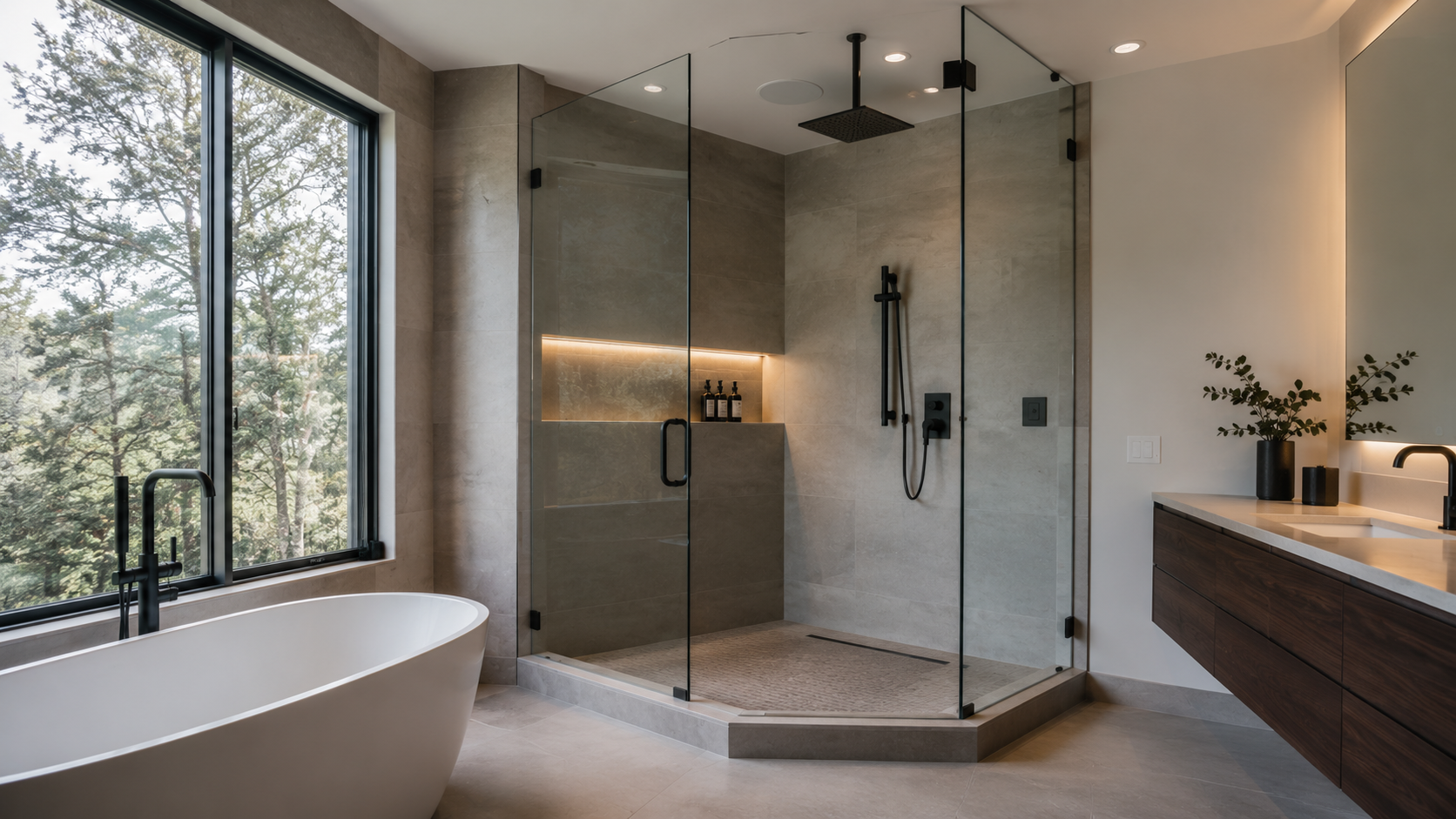
Framed shower doors are forgiving. The frame absorbs a lot of variation, and nobody notices.
Frameless enclosures are the opposite. There’s no frame to hide behind, so every condition in that bathroom shows up in the finished product. When a frameless install goes badly, the glass is almost never the problem. The room is.
Here are the four conditions that decide how it goes, and what you can do about each one before anyone measures.
1. Walls that aren't plumb
This is the big one.
A wall that leans across the height of an enclosure creates a tapered gap along the glass edge — wide at one end, tight at the other. On a frameless unit that gap is visible from across the room, and there’s no hardware adjustment that removes it.
Normal framing and tile tolerance can produce this without anyone making a mistake. The issue is that “normal” for a painted wall and “normal” for a frameless enclosure aren’t the same standard.
What to do: flag the enclosure walls as plumb-critical before framing, and again before tile. If a wall is already out, tell your glazing sub at measure rather than hoping. Glass can be engineered around a known condition. It cannot be engineered around a surprise.
2. Curbs that aren't level — or pitch the wrong way
The curb has two jobs that fight each other: it has to shed water back into the shower, and it has to give the glass a level, flat surface to sit on.
A curb that’s out of level makes the door hang wrong and the seal sit unevenly. A curb that pitches outward sends water onto your finished floor, and that call comes six weeks after you’ve been paid.
What to do: set the curb so the top surface pitches slightly inward, and keep it level end to end. Confirm the finished curb width works with the glass and hardware you’ve specified — a curb that’s too narrow limits your options on channel and clamp hardware.
3. Tile that isn't flat
Plumb and flat are different problems. A wall can be perfectly plumb overall and still have lippage between tiles, a bowed section, or a bulge at a corner.
Frameless hardware — clamps, hinges, channels — needs a flat bearing surface. Mount a hinge over uneven tile and you’re either shimming it or putting a twisting load on the glass. Neither one ages well.
What to do: pay extra attention to flatness in the hinge and clamp zones specifically. Your tile setter doesn’t automatically know where those land, so tell them. Large-format tile makes this harder, not easier.
4. Blocking, waterproofing, and timing
Heavy frameless doors and header supports need solid backing behind the tile. That decision happens at framing and becomes very expensive after tile.
Waterproofing has to be complete and cured before anything gets fastened through the finish surface — and before the field measure, because we measure the finished surface, not the substrate.
What to do: get blocking locations confirmed during framing. Schedule the field measure after tile and waterproofing are complete, not before. Measuring early is the fastest way to end up with a beautiful piece of glass that doesn’t fit anything.
The tolerance conversation nobody has
Here’s the honest version: every frameless enclosure has some amount of variation to absorb, and a good glazing sub builds that into the layout. What we can’t do is absorb variation we didn’t know about.
That’s why the field measure matters and why it happens when it happens. A measure on finished surfaces, with the actual conditions in front of us, is how a custom piece of glass drops in cleanly the first time.
How we prevent it on our jobs
We’d rather walk your bathroom during framing than at tile. When we’re in early, we tell your framer where blocking goes and tell your tile contractor which walls and zones matter most. At field measure, we catch conditions before they become reorders — and if something needs to change in the layout, you hear it from us before anything is ordered.
You also get a free visual mockup before the order goes in, so your client is signing off on the layout, hardware, and finish up front instead of at install.
Frameless work is the most visible thing we do. That’s exactly why we’re careful about the parts nobody sees.
Getting started is simple:
Email Aim Fuller Glass your project details.
Get a personal consultation and free visual mockup.
Get glass handled by the pros — on time.